DFW sits on Irving's western doorstep — and that's part of what makes it one of the most logistically interesting airports in the country for group travel. The airport is enormous: five terminal buildings strung along International Parkway, every one of them accessed through toll plazas, with rideshare running from the upper level while charter buses and shuttles work the lower-level curbside below. For a solo traveler with one carry-on and an Uber already pinged, that system works fine.
For a group of 25 pulling luggage from baggage claim at Terminal D after a long international flight, it's a different calculation entirely — and the difference between "everyone ready at the curb" and "half the group still at baggage claim" is exactly the gap that costs you a full extra loop around the terminal road.
This guide covers how a charter bus or party bus from the Irving area actually works at DFW: the lower-level curbside pickup rules at each terminal, the Ground Transportation permit requirement, why the bus cannot sit at the curb and wait, and what the group leader needs to do to make the pickup clean. It also covers the approach from Irving — SH-114 and SH-183 into International Parkway, the toll structure, and the buffer time any group planner needs to build in. Fill out the quick form or call 214-540-6746 any time to get pricing for your group in about a minute.
Why Renting a Bus to DFW Makes Sense for Irving Groups
Getting to DFW from central Irving is quick — roughly 10 miles via SH-114 or SH-183, typically 15–20 minutes in normal traffic. But "quick" and "easy for a group" are different things. When eight people need to reach the airport for an 8 a.m. departure, that means multiple cars, multiple parking transactions at the terminal garage (up to $27/day per vehicle), and a coordination headache that starts before anyone rolls a bag out the door.
A single Irving charter bus covers all of it: one vehicle, one drop-off on the upper departure-level curbside, and no one peeling off to hunt a parking space at 6 a.m.
The return trip is where it gets messier. Flights land scattered across five terminals, bags take their time, and the group reassembles slowly at baggage claim. Rideshare pickups at DFW work the upper level of each terminal, not the lower level where your luggage comes out — so the group has to get back up to Departures to catch a ride, often while airport police are moving cars off the curb every 90 seconds.
One bus coordinated through Partybusirving.com waits in a remote holding area and comes to the lower-level curbside only when the group leader confirms everyone is standing there with bags in hand. No app, no surge pricing, no splitting into three separate Lyfts.
DFW Terminal Guide: Who Flies Where
Before you can plan the pickup, you need to know which terminal your flight uses — because the five terminals at DFW are not interchangeable, and a bus staged at Terminal A while your group exits Terminal D costs you time and money.
Terminal A handles American Airlines domestic mainline flights on gates A1–A39. Terminal B is primarily American Eagle regional operations, gates B1–B49. Terminal C covers more American Airlines domestic and regional service, C2–C39.
Terminal D is DFW's international gateway — American Airlines international departures and arrivals share the space with Air France, British Airways, Emirates, Lufthansa, Korean Air, Qatar Airways, and about a dozen other carriers. Terminal E handles Delta, United, Alaska Airlines, JetBlue, Frontier, and Air Canada, along with some overflow American gates at E35–E38.
If your group is on a domestic American flight, you're almost certainly in A, B, or C. International arrivals land in D. And if half your group is on Delta or United while the other half is on American, you're looking at two different lower-level curbsides on two different sides of the terminal loop — which is exactly the scenario where one charter bus with a clear plan beats a caravan of rideshares every single time. Check your booking confirmation against this list and write down the terminal before the trip, not while you're pulling bags off the carousel.
Charter Bus and Party Bus Drop-Off at DFW: How the Lower-Level Curbside Works
Here's the split that surprises first-timers: rideshare vehicles (Uber, Lyft) pick up at the upper level of each terminal — the same level where you drop off departing passengers. Charter buses and commercial shuttles work the lower level, which is the Arrivals and baggage claim level. That's the curbside your group walks out to after collecting luggage, and it's where a bus from the network needs to be staged when you make the pickup call.
DFW marks the lower-level curbside with ground transportation signage, and wide lanes are in place at each terminal to accommodate larger vehicles. For departures, the bus drops your group on the upper-level curbside and rolls — the airport's published guidance makes clear that curbsides are designated for active loading and unloading only, with no vehicle left unattended. For airport arrivals, the bus holds in a remote staging area until the group leader makes the call.
One note on Terminal C: the lower level runs congested more often than the others, particularly during construction periods. If your group lands at Terminal C with a large party, the DFW Skylink — a free automated train connecting all five terminals at the gate level — lets everyone shift to Terminal D's lower level, which typically has more room to maneuver for oversized vehicles. That option is worth knowing about before you land, not after.
Upper level is rideshare. Lower level is your bus. Charter and shuttle vehicles work the Arrivals curbside at the lower level of every terminal at DFW.
Rideshare vehicles (Uber, Lyft) pick up at the upper Departures level — the same level you use to drop off outbound passengers. The two systems run on entirely separate traffic flows.
The Ground Transportation Permit Requirement at DFW
Not just any vehicle can stage at DFW's commercial pickup zones. DFW's Ground Transportation Administration issues company, vehicle, and personnel permits to commercial transportation providers regulated under Chapters 4 and 5 of the DFW Board Code of Rules and Regulations. That covers every category of commercial ground transport operating at the airport — charter buses, shuttles, sedans, and motorcoaches all require their own authorization from the Ground Transportation Administration before a vehicle can legally work the terminal curbsides.
What that means for your group: when you compare charter bus and party bus options through Partybusirving.com, the network connects you with companies that hold the required commercial authorization to operate at DFW. That's what makes the pickup procedure clean — a permitted vehicle can approach the lower-level curbside when called, stage in the designated remote holding area while it waits, and move through the terminal loop without getting flagged by airport police. An unpermitted vehicle attempting to pick up a group at the terminal curb is a much messier situation.
The permit structure exists for exactly this reason, and it's already handled when you book through the network.
Why the Bus Cannot Idle at the DFW Curb — and What Happens if Your Group Isn't Ready
This is the single most important logistical fact about DFW charter bus pickups, and most groups don't know it until it costs them 20 minutes. The airport's curbsides are designated for active loading and unloading only. No vehicle — not a sedan, not a shuttle, not a 56-passenger motorcoach — can sit at the lower-level curb with the group not present.
Airport police monitor the curbsides actively, and any vehicle that lingers without actively loading passengers gets directed to recirculate.
For a passenger car, that recirculation is a minor inconvenience. For a charter bus working the terminal loop at DFW, a forced re-circulation adds approximately 20 minutes — the time it takes to exit the terminal road, loop around, clear the toll structure, and return to the lower-level curbside. If your 30-person group triggers that loop once, you've added 20 minutes to your departure time on the back end of an already-long travel day.
Trigger it twice and you're looking at close to 40 minutes of delay for something entirely preventable.
The 20-minute penalty is avoidable with one rule: the group leader does not call for the bus until every person in the group has their luggage and is standing at the lower-level curbside. Not "most of the group." Not "we're almost all here."
Everyone. Bags in hand. Feet on the curb.
Then make the call.
The Group Leader Calls When Everyone Is Curbside
The procedure that prevents the re-circulation penalty is simple, but it takes discipline to execute in a busy arrival hall. Designate one person as the group leader before anyone gets on the plane — this is the person who communicates with the bus network while the rest of the group collects luggage. Once the flight lands, the group leader's job is to stay in contact with the rest of the group as they clear baggage claim and to hold off on calling the bus until the full headcount is confirmed at the lower-level curbside exit.
The bus stages in a remote holding area — for DFW, that's either the North or South cell phone lot (North: 53 spaces before the North toll plaza; South: approximately 60 spaces near Rental Car Drive and Southgate Avenue), or in a designated commercial staging area — from which a 5–10 minute drive reaches any terminal's lower-level curbside. When the group leader calls, the bus moves. By the time it arrives at the curb, the group should be standing there, bags loaded, ready to board.
That's the whole system. The part that breaks it is calling too early while stragglers are still at the carousel.
For groups with members arriving on different flights or from different baggage claim carousels, the same principle applies: the call goes out only after the last person in the last wave has cleared baggage claim and is at the curb. A staged bus sitting in the lot burns no one's time; a bus that arrives to a half-assembled group burns 20 minutes for everyone.
Building Buffer for the Terminal Loop: How Much Time to Add
The DFW terminal road is a continuous loop along International Parkway. In light traffic, the drive from the cell phone lot to a terminal curbside runs 5–10 minutes. During peak arrival windows — midday, late afternoon, and especially the cluster of international arrivals that typically land in Terminal D between 4 and 7 p.m. — the terminal loop backs up, and the same drive can stretch to 15–20 minutes even without a forced recirculation.
The honest planning number for any DFW charter bus pickup is a 30-minute buffer from wheels-down to bus-at-curb. Baggage claim at DFW typically takes 20–30 minutes, the walk to the lower-level exit adds a few more, and you need the group leader to wait for the last bag before calling. Tell the person who books the bus what time the flight lands, not what time you want to leave the airport — and add 30 minutes to that landing time for the realistic departure window.
Groups that plan this correctly are in the bus and rolling in under an hour. Groups that try to shortcut the baggage claim wait trigger the recirculation, add 20 minutes, and end up slower than they would have been.
Approaching DFW from Irving: SH-114, SH-183, and the International Parkway Toll
From Irving, there are two main approaches to DFW, and which one you take depends on where in Irving you're starting. The official DFW directions page identifies State Highway 114 (John W. Carpenter Freeway) as the northern approach and State Highway 183 (Airport Freeway) as the southern one. From north Irving and Las Colinas, SH-114 heading west feeds into the airport's north entry and connects to the North toll plaza on International Parkway.
From central and south Irving, SH-183 heading west reaches the South toll plaza. Either way, you enter International Parkway — the single north-south road that connects all five terminals and runs the full length of the airport.
International Parkway is a toll road, and every vehicle entering pays — including the bus. The toll structure is time-based: $9 for trips under 8 minutes (essentially a pass-through charge designed to discourage people from using the airport road as a shortcut) and $2 for trips lasting 8–30 minutes. Payment at entry plazas is cashless — TollTag or contactless credit/debit only.
No cash lanes exist at DFW's toll plazas. For a charter bus picking up at one terminal and exiting the airport, the toll is a minor line item. For a group planning to hit multiple terminals in one run — picking up split parties from different airlines — the loop time and the toll structure are both worth knowing in advance so the trip isn't a surprise.
No cash at DFW toll plazas. International Parkway charges are collected cashlessly — TollTag or contactless card only. Commercial vehicles entering through the North or South plaza pay on entry or exit.
The toll cost for a single terminal run is a small number; the trip-within-8-minutes rate of $9 exists specifically to deter vehicles from passing through without stopping.
What Size Bus Does Your Group Need for a DFW Run?
The right vehicle depends on headcount, how much luggage your group is carrying, and whether the trip is a pure airport transfer or part of a larger itinerary. DFW runs are almost always luggage-heavy — international travel especially — which puts a premium on undercarriage storage capacity.
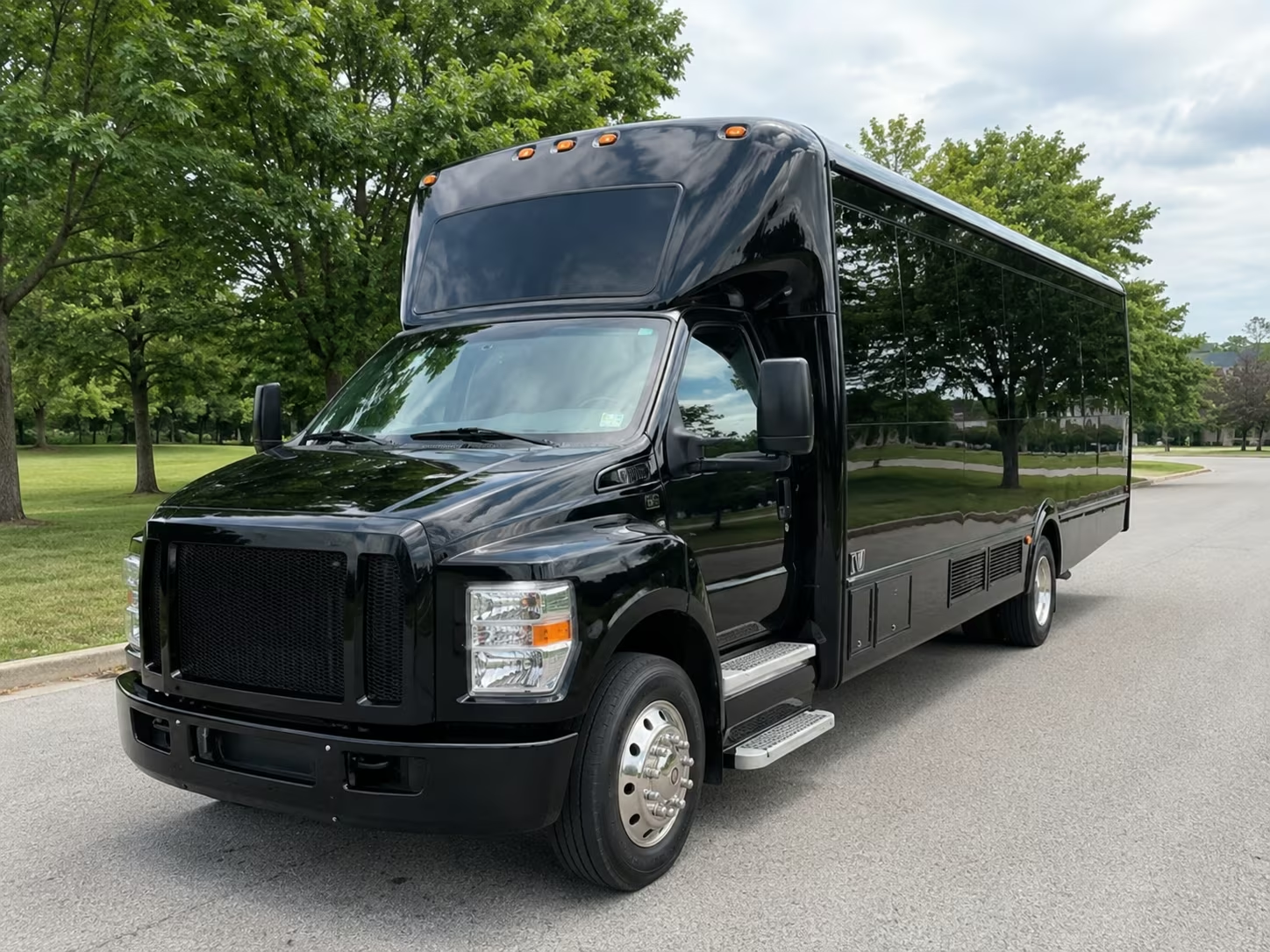
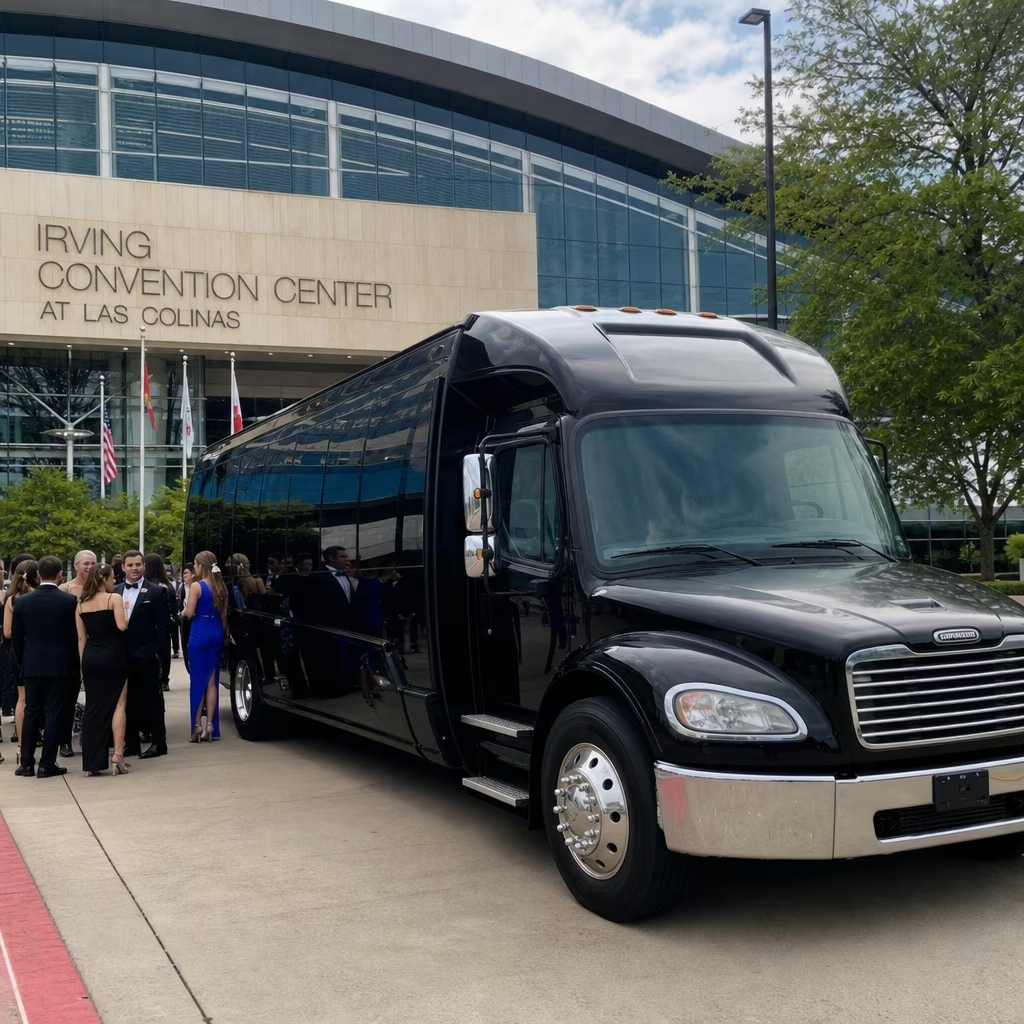
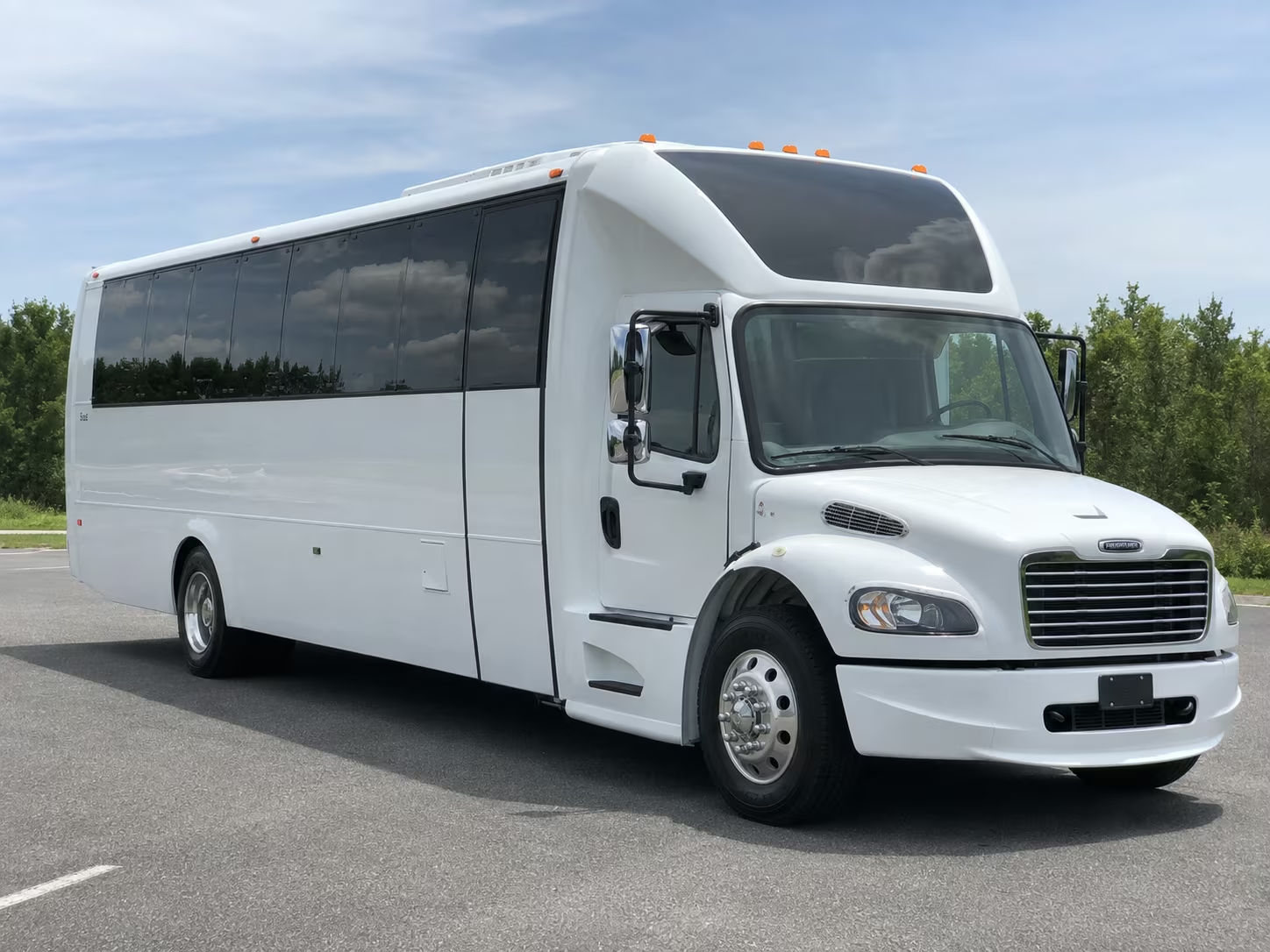
For groups of 10–15 with moderate luggage, a 15–35 passenger minibus is a practical fit — it navigates the terminal loop more easily than a full-size coach and gets in and out of the lower-level commercial lanes with less maneuvering. Groups of 20–30 have multiple options: a 25-passenger party bus or 28-passenger party bus works if the trip includes a celebration leg, while a minibus with overhead and underfloor storage is the cleaner call for a pure airport transfer with heavy bags. For larger groups — 40 to 56 people coming in on a group tour or a company offsite — a 40–56 passenger charter bus is the answer: deep undercarriage bays that handle the luggage load, an onboard restroom for the ride back to Irving, and reclining seats that make a long post-flight drive comfortable instead of something to endure.
Note that full-size charter buses may face height restrictions in some terminal garage structures at DFW, which is another reason the lower-level curbside pickup (with the bus staged externally) is the standard procedure for commercial vehicles. Browse the full vehicle lineup or call 214-540-6746 and describe your headcount, your luggage situation, and where you're headed after the airport — a support team can match the right vehicle to your exact trip in a few minutes.
| Vehicle | Seats | Luggage capacity | Best for |
|---|---|---|---|
| Sprinter Van | Up to 14 | Modest — personal bags, small group | Small groups, executive transfers, quick Irving-to-DFW runs |
| 14-Passenger Sprinter Limo | Up to 14 | Moderate | VIP airport pickups, smaller group in style |
| 15–35 Passenger Minibus | 15–35 | Good — overhead + some underfloor | Mid-size groups, heavy luggage, maneuverable in terminal loop |
| 40–56 Passenger Charter Bus | Up to 56 | Excellent — deep undercarriage bays | Large group arrivals/departures, tour groups, company retreats |
What It Costs: Irving to DFW Bus Rental Prices
Rental rates for a DFW airport run from Irving move with vehicle size, the time of day, and how long the bus is on the clock. To give you a planning range: a minibus runs roughly $200–$250 per hour on weekdays, $200–$275 on weekends; a full charter bus typically ranges from $200–$350 per hour depending on the day and availability. A Sprinter van runs $200–$275 per hour on weekdays.
Those are planning figures — the actual quote for your specific date, group size, and route is what you get when you fill out the form or call 214-540-6746. A tailored quote takes about a minute to generate through the Irving airport transportation page.
Once you split the cost across 20 or 30 people, the per-head number usually looks very different from what people expect. Terminal parking at DFW runs up to $27 per day per vehicle — for a group of 25 flying out for a four-day trip, five or six cars at $27/day adds up to $540–$648 in parking alone, before gas, before the hassle of coordinating drop-off and pickup times across multiple vehicles, before the Uber surge at 6 a.m. on a Sunday. One bus and one flat rate removes all of that math.
See the Irving party bus prices page for a broader look at what different vehicles typically run.
Transit Options: DART Orange and Silver Lines, TEXRail, and When They Work for Groups
DFW has real rail access, and it's worth knowing about — both so you understand when it's the right call for your situation, and so you know when it isn't. The DART Orange Line connects Irving directly to DFW Terminal A, near Gate A10. If you're in Las Colinas or downtown Irving, the Orange Line stops at Las Colinas Urban Center, Irving Convention Center, and several other stations before running west to Terminal A. For a solo traveler or a couple with carry-on bags, the Orange Line is a genuinely good option.
The DART rail connection page has current schedules and fares.
The DART Silver Line reaches Terminal B (near Gate B43) via a northern corridor through Carrollton, Addison, and Richardson — not through Irving, but useful for groups based farther north. TEXRail connects downtown Fort Worth through Grapevine to Terminal B. And the Trinity Railway Express (TRE) reaches the CentrePort/DFW station, with a TRE Link shuttle to Terminal D from there.
The honest assessment for group travel: DART and TEXRail work well for individuals, small traveling pairs, and any group where everyone is fit to stand, has carry-on bags only, and is departing from Terminal A or B. For a 20-person group with checked luggage coming from a hotel block in Las Colinas, the logistics of coordinating everyone on the Orange Line — fare payment, bags on the platform, connecting at Terminal A when half the group needs Terminal D — typically cost more in time and stress than a bus. Groups with strollers, medical equipment, oversized athletic gear, or passengers with mobility needs should book a vehicle. Everyone else: match the transit option to your specific headcount and luggage reality.
DFW Airport vs. Dallas Love Field: Which Airport Does Your Group Use?
Irving groups occasionally have a choice between DFW and Dallas Love Field (DAL) depending on the airline and fare. Love Field is about 11 miles from central Irving — similar distance to DFW — and primarily serves Southwest Airlines, with limited service from a handful of other carriers. It's a significantly smaller airport: one terminal, one baggage claim area, and a much simpler curbside pickup situation than DFW's five-terminal loop.
If your entire group is flying Southwest and Love Field comes up as the cheaper option, the ground transportation logistics are actually simpler than DFW — the pickup zone is easier to navigate for commercial vehicles, and there's no multi-terminal coordination problem.
For most Irving groups on any carrier other than Southwest, DFW is the airport. And for international travel, DFW's Terminal D is the only game in town for most routes. The bus works the same way at either airport — lower-level curbside, group leader calls when everyone is ready — but the scale is different enough that groups who've only used Love Field can be caught off guard by DFW's terminal loop the first time.
Departure Day Coordination: A Step-by-Step Timeline for Group Departures
The departure leg is simpler than arrivals because you control the timing — but groups still get this wrong by underestimating how long it takes to load 30 people and their bags. Here's a working timeline for a morning group departure from Irving.
Build in at least 30 minutes for loading at your Irving pickup point — longer if you have seniors in the group, children, or equipment like golf bags or team gear. The bus needs to reach the upper-level departure curbside with enough time for the group to unload, collect bags, and get through security without a sprint to the gate. TSA wait times at DFW vary by terminal and time of day; the airport recommends arriving at least two hours before domestic departures and three hours for international.
Plan the bus departure from Irving around a three-hour pre-flight window for domestic flights, and add an extra 30 minutes for international.
The bus drops the group at the upper-level curbside of the correct terminal — you confirmed the terminal from the itinerary, not from memory — and moves immediately. Everyone grabs their bags from the undercarriage bays as they come off, the group leader does a headcount, and the group moves into the terminal together. One phone number, one vehicle, one departure point.
That's the whole operation.
Frequently Asked Questions About DFW Charter Bus and Party Bus Rentals
Where exactly does a charter bus pick up at DFW airport?
Charter buses and commercial shuttles work the lower level (Arrivals/baggage claim level) curbside at each terminal — A through E. That's the level you exit to after collecting luggage. Rideshare vehicles (Uber, Lyft) run from the upper level (Departures). The two systems operate on separate traffic flows.
Your group's meeting point after landing is always the lower-level curbside exit of your arrival terminal, not the upper level where you'd drop off departing passengers.
Can the bus wait for us at the curb while we get our luggage?
No — DFW's curbsides are designated for active loading and unloading only. A bus that arrives to an unprepared group gets directed by airport police to re-circulate, which adds approximately 20 minutes to the pickup. The correct sequence: the group leader holds off on calling the bus until every person in the group has their luggage and is standing at the lower-level curbside exit.
Then the call goes out, the bus moves from its remote staging area, and it arrives to a group that's ready to board.
How long should we plan between landing and being in the bus?
Plan 30–45 minutes from wheels-down to bus departure for a domestic arrival; up to an hour for international arrivals, which typically involve customs and a longer baggage claim wait. The bus stages in a remote area (the North or South cell phone lot, or a designated commercial zone) and takes 5–10 minutes to reach the terminal curbside in normal traffic, up to 15–20 minutes during busy periods. Build that buffer into your schedule when you book.
What permit does a bus company need to pick up at DFW?
DFW's Ground Transportation Administration issues company, vehicle, and personnel permits to commercial transportation providers regulated under the DFW Board Code of Rules and Regulations. Any vehicle legally working the terminal curbsides holds this authorization. When you compare options through Partybusirving.com, the network connects you with companies that already hold the required commercial permits for DFW operations.
Which terminal should I tell the bus to go to?
Check your boarding pass or itinerary for the terminal letter — your airline's check-in or booking confirmation will show it. As a general guide: American Airlines domestic flights use Terminals A, B, and C; international flights for most carriers (including American's international routes) use Terminal D; Delta, United, Alaska, JetBlue, Frontier, and Air Canada use Terminal E. If your group has members on different airlines arriving at different terminals, coordinate pickups in sequence and call the bus only after the last sub-group clears baggage claim.
How much does a charter bus or party bus from Irving to DFW cost?
Rates move with vehicle size, time of day, and how long you need the bus. A minibus typically runs $200–$275 per hour; a full charter bus ranges from $200–$350 per hour; a Sprinter van runs $200–$275 per hour on weekdays. Those are planning ranges — fill out the form on Partybusirving.com or call 214-540-6746 and you'll have a quote for your specific trip in about a minute.
Is there a toll to access DFW airport?
Yes. International Parkway — the road that connects all five terminals — charges a toll at both the North and South entry plazas. The rate is $9 for trips lasting under 8 minutes and $2 for trips lasting 8–30 minutes.
Payment is cashless only: TollTag or contactless credit/debit card. No cash lanes exist at DFW toll plazas. See the official DFW directions page for current entry and payment information.
Is DART a good option for a group going to the airport from Irving?
For individuals or pairs with carry-on bags, the DART Orange Line from Irving to Terminal A is a solid option — it avoids the toll and the terminal loop entirely. For groups of 10 or more with checked luggage, the coordination logistics (keeping the group together on the platform, handling bags, and navigating from Terminal A to D or E if that's where the flight departs) usually tip the balance toward a bus. The DART connection page has current schedules and fares if you want to weigh the option for your group size.
Where does a charter bus drop off for a departure at DFW?
For departing flights, the bus drops the group at the upper-level departure curbside of the correct terminal, then moves immediately per the airport's active-loading rules. Confirm the terminal letter from your itinerary before the day of travel, not at the drop-off curb — Terminal D and Terminal E, for example, are on opposite sides of the International Parkway loop and are not a quick walk apart.
Book Your Irving to DFW Charter Bus or Party Bus Today
Whether your group is flying out for a company offsite, returning from an international trip, or coordinating a reunion arrival across two terminals, a charter bus from the Irving area handles the whole logistics problem in one number. One pickup point, one curbside drop-off, one group leader call when everyone is ready — and no one is circling the terminal garage at $27 a day.
Partybusirving.com makes it easy to compare party bus and charter bus options serving Irving and the entire DFW area. Fill out the quick form or call 214-540-6746 any time — quotes take about a minute, no account required, no obligation. For group corporate travel to and from the airport, the Irving corporate event transportation page covers shuttles for larger company moves.
And if DFW isn't your only destination on this trip, the guides for AT&T Stadium and American Airlines Center cover bus drop-off and parking for those venues in the same detail.